

I own more than five hundred wigs. They live in a basement that my friends politely call a museum and my family calls a problem. Of all of them, the curly ones demand the most from me and give back the most when I get it right. A good curl pattern is a living structure, and frizz is simply what happens when that structure gets disturbed. The good news is that frizz is not a mystery and it is not permanent. It is a maintenance problem, and maintenance problems have solutions.
This guide covers what actually causes frizz in curly wigs, how to wash and dry them without destroying the curl, how to hydrate and style them, how to store them so they survive the week, and how to rescue a curly wig that has already gone fuzzy. The principles apply whether you are wearing a lace front, a 4x4 closure unit, a U-part, or a simple capless synthetic bob with a bit of wave.
Why Curly Wigs Frizz So Easily
A curl is a helix, and a helix is held in shape by hydrogen bonds inside the hair fibre plus the way the cuticle layers wrap around each other. When the cuticle is smooth and the fibre is pliable, the curl clumps together into tidy spirals. When the cuticle lifts, individual strands separate, grab light in every direction, and turn into the halo of fuzz we call frizz.
Curly wigs are more vulnerable than straight ones for three reasons. First, there is simply more surface area on a curled strand, so more cuticle is exposed to friction. Second, the curl pattern creates natural weak points where the fibre bends, and those bends are where dryness and breakage start. Third, the curl clumps need to stay clumped. Every time you comb through a dry curl, you break a clump apart, and clumps do not reassemble themselves without help.
- Dry brushing or combing a dry curly wig, which shatters curl clumps instantly
- Cotton pillowcases and rough towel drying, which sand the cuticle with every movement
- Alcohol-based styling products that dry out the fibre and leave it brittle
- Hot tools used on dry hair without heat protection, especially flat irons and small-barrel wands
- Over-washing, which strips the natural oils from human hair and the conditioning coating from synthetic fibre
- Friction against coat collars, scarves, and backpack straps, which roughs up the mid-lengths and ends
If you remember nothing else from this article, remember this: the enemy of a curly wig is manipulation while dry. Almost every frizz disaster I have documented in my own collection traces back to that single mistake.
The Five Rules I Never Break
- Never detangle dry. Wet the wig with water or a leave-in conditioner first, always.
- Work from the ends upward. Start at the tips and move toward the roots, never the other way around.
- Use a wide-tooth comb or your fingers, not a fine brush. Curls need room to move.
- Hydrate in layers, not in one heavy dump of product. Thin layers, scrunched in, absorb better.
- Let curls dry undisturbed. Touching a drying curl is the fastest way to create frizz.
Those five rules carry most of the weight. Everything below is just the detail work.
Washing a Curly Wig Without Unravelling It
Wash less often than you think. A human hair curly wig worn daily can go seven to ten wears between washes if you spot-clean the lace and refresh the mid-lengths in between. A synthetic wig can often go longer, because synthetics do not absorb oils from your scalp the way human hair does. When it does need a wash, treat it like fine knitwear, not like laundry.
- Fill a basin with cool or lukewarm water. Hot water opens the cuticle and invites frizz.
- Add a small amount of sulfate-free shampoo and swirl it through the water rather than pouring it on the fibre.
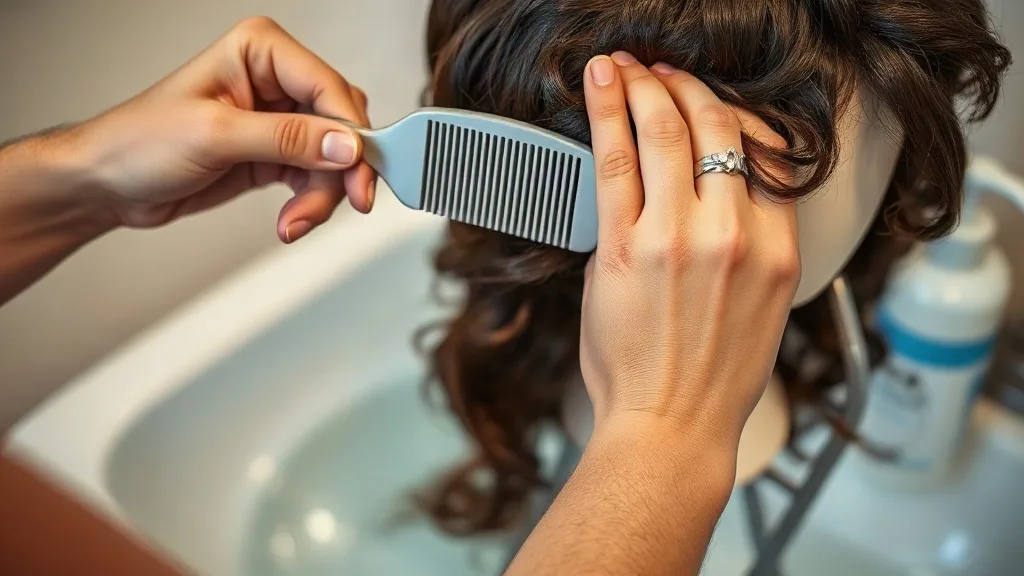
- Submerge the wig and gently squeeze the suds through from roots to ends. Do not scrub, twist, or bunch it up.
- Rinse in cool water until it runs clear. Never comb the wig while it is full of shampoo.
- Apply conditioner from mid-length to ends. Avoid the knots and the cap, which do not need conditioning.
- Detangle gently with a wide-tooth comb while the conditioner is still in, working from the ends up.
- Rinse again in cool water, then press the excess water out with a towel. Do not wring.
Drying: The Step Most People Ruin
Drying is where curly wigs are won or lost. The goal is to remove water without disturbing the clumps you have carefully preserved during washing. Microfibre towels and old cotton t-shirts are your friends here. Terry cloth towels are not, because the looped pile catches individual strands and pulls them out of formation.
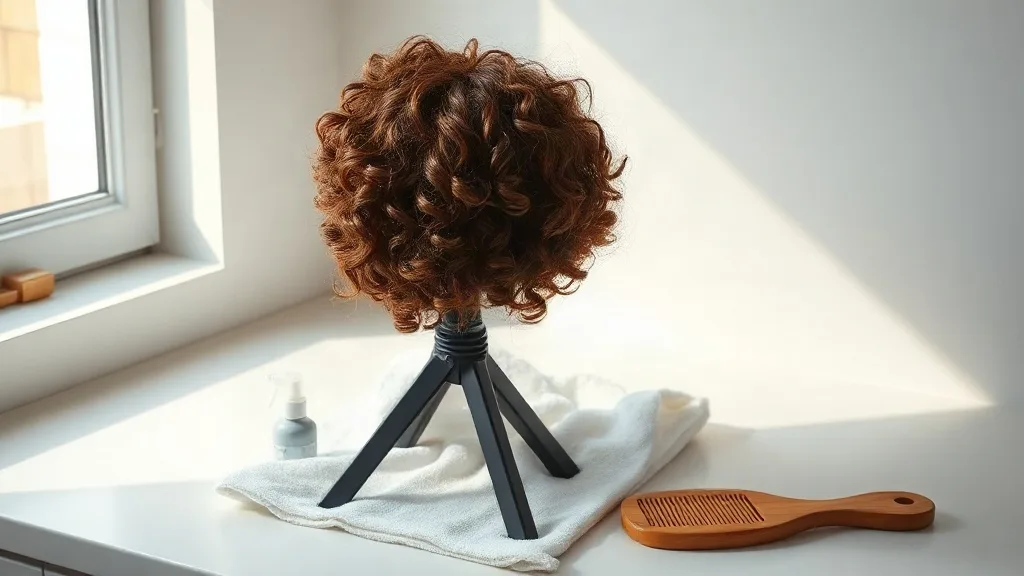
Place the wet wig on a folding wig stand that allows air to circulate underneath the cap. If the wig has a defined curl pattern you want to keep, cup the curls in your hands and press them upward toward the scalp, a motion usually called scrunching, then leave it alone. Air drying takes longer, but it produces the most natural result. If you must use a diffuser, keep it on the lowest heat and speed settings, hold it still for a few seconds at a time, and never rake it through the hair. Stop when the wig is about eighty percent dry and let the rest happen on its own.
- Never dry a curly wig on a radiator, in direct sun, or with a hairdryer on high heat
- Never brush or comb a drying wig
- Never hang a soaking wet wig by the lace, which stretches and distorts the cap
- For synthetic wigs, check the fibre's heat tolerance before using any warm air at all
Hydration: Products, Order, and Restraint
Curls need moisture, but they need it in the right order and the right amount. Think of it as layering: water first, then a light leave-in, then a curl cream or defining product, then a sealant. Heavy oils applied to dry fibre sit on top and do nothing. The same oils applied over a damp leave-in lock the moisture in and make the curl look smooth.
- Leave-in conditioner: the foundation layer, applied to damp hair in a small amount
- Curl cream or defining lotion: creates clumps and controls shape, applied by scrunching
- Light oil or serum: seals the cuticle at the ends, used sparingly and only on the last few inches
- Mousse: useful for synthetic wigs and fine curls, adds body without weight
- Avoid anything with a high alcohol content, which evaporates and takes moisture with it
For synthetic curly wigs, the product list shrinks. Synthetic fibre cannot absorb conditioner the way human hair can, so leave-in sprays formulated for synthetic wigs, plus a light silicone-based serum, are usually all you need. Never use heavy oils on synthetic fibre, because they build up and dull the shine permanently.
Sleeping, Storage, and My Basement Museum Method
Most frizz happens while you are asleep. Cotton pillowcases create friction, and friction roughs the cuticle with every turn of your head. A silk or satin pillowcase, or a satin-lined sleep cap, solves most of this problem for wigs you sleep in. For wigs you take off at night, the goal is to preserve the curl shape rather than flatten it.
My own method, refined over five hundred pieces, is simple. Each wig goes on its own canvas wig block, gets a light mist of leave-in or synthetic conditioning spray, is gently finger-combed back into its clumps, and is then covered with a silk scarf. The blocks sit in a dust-free cabinet, labelled, and every wig is numbered in a catalogue with the date it was last washed and conditioned. I am aware of how that sounds. It works.
- Use a mannequin head or canvas block that matches the wig's cap size so the cap does not stretch
- Cover with silk or satin, never plastic, which traps moisture and encourages mildew
- Store away from direct sunlight, which fades colour and degrades fibre over time
- Keep synthetic and human hair wigs separate so fibres do not tangle together
- For travel, turn the wig inside out, place it in a silk bag, and pack it at the top of the case
Styling: Definition, Separation, and Blending
Once the wig is dry, styling is about refinement rather than reshaping. If you want more definition, dampen your fingertips with a light leave-in or a curl refresher spray and twirl individual curls around your finger, working section by section. This is slow, meditative work, and it is exactly how you get the kind of definition that looks intentional rather than crunchy.
- Refresh with water and a light leave-in before you add any new product
- Twirl curls individually with a damp fingertip rather than combing the whole head
- Separate clumps only after the wig is completely dry, and only with your fingers
- Blend your own hairline using a small amount of edge control or a spritz of water and a soft brush
- Set the final shape with a light hold spray held at least ten inches away
If you wear a lace front, remember that the hairline is the part people read as real. Keep the front curls slightly looser and less product-heavy than the rest of the head, because a stiff, sculpted hairline is the giveaway that something is a wig. Softness at the front, definition in the body.
Reviving a Curly Wig That Has Already Frizzed
Frizz is rarely fatal. Before you retire a wig to the back of the cabinet, try a full reset. Mist the entire wig generously with water or a curl refresher until it is damp but not dripping. Apply a small amount of leave-in conditioner, then scrunch the fibre upward in sections to encourage the curl to re-clump. Let it air dry without touching it. For stubborn cases on human hair, a steamer held a few inches away can relax the roughened cuticle and bring the curl back into formation.
Synthetic wigs respond well to steam, but heat is a genuine risk. Always check the fibre's heat tolerance, keep the steamer moving, and never let a hot tool sit against the fibre. If the ends are truly beyond saving, a light trim of half an inch can restore the appearance of the whole unit. I have rescued wigs from what looked like terminal fuzz this way more times than I can count.
A Simple Weekly and Monthly Routine
Consistency matters more than any single product. Here is the schedule I follow for the curly wigs currently in rotation.
- After every wear: mist with leave-in, finger-comb back into shape, cover with silk, and place on a block
- Weekly: spot-clean the lace and cap, refresh the mid-lengths and ends, and check for tangles near the nape
- Monthly: full wash, deep condition for human hair, and a careful inspection of the cap and knots
- Every three months: review the curl pattern, trim split or rough ends, and decide whether the wig needs a rest period
Final Thoughts, or Why I Number Every Wig
Curly wigs reward patience more than any other type. They will not tolerate being rushed, brushed dry, or blasted with heat, but they also do not need much beyond water, restraint, and a silk scarf. Get the basics right and a good curly unit will hold its bounce for years, not weeks.
Every wig in my collection has a number and a page in the catalogue. Number 212 is a shoulder-length human hair unit with a springy 3B pattern that I have owned for eleven years and washed roughly ninety times. It still clumps. It still bounces. It has never once been brushed dry. That is the entire secret, and now you have it too.