
There is a particular silence in the wings before a variation begins: the hush of rosin settling into the floor, the last tug of a pointe shoe ribbon, and one final check of the hairline in the mirror. In those thirty seconds, everything you own is either working for you or working against you. I have built and maintained wigs for ballet for well over a decade — feathered crowns for Odette, windblown ponytails for Kitri, and the severe, immovable buns that have to survive a full pas de deux without a single strand escaping. After all of it, I can tell you the biggest variable in whether a wig survives a season is not the cap construction or the knotting. It is what you put on it.
This guide covers the products actually worth your money — serums, sprays, and treatments — and the popular ones that will quietly ruin a beautiful wig. Nothing here is sponsored. Every recommendation is judged against one question: does this make the wig last longer, look better, and stay where I put it?
Why a Wig's Needs Are Not Your Hair's Needs
A wig has no scalp. It has no sebum, no natural oil production, no blood supply, and no ability to heal itself. Human hair on a wig has already been processed at least once — typically acid-washed, dyed, and stripped of its cuticle alignment — and synthetic fiber is essentially extruded plastic with a memory programmed into it. Both are dead materials pretending to be alive. That changes everything about how you should treat them.
- Nothing replenishes moisture in a wig except what you deliberately apply — there is no oil rising from the root to help you
- Product builds up worst at the knots and along the lace, exactly where it is hardest to remove without damage
- Shed strands are permanent. There is no regrowth, so every broken fiber is a fiber you have lost forever
- Wet fiber stretches. Brushing a wet wig is one of the fastest ways to thin a hairline
- Heat, alcohol, sunlight, and friction degrade human hair and synthetic fiber on different timelines, but they all degrade them
How I Test (And Why the Bar Is High)
During a production I rotate four or five wigs, some of them worn eight shows a week. When I test a product, I apply it to one wig and leave a similar control wig untouched, then compare them every few days for three weeks. I am looking for four things: knot integrity at the lace, slip through the mid-lengths, surface shine under stage lighting, and residue. That last one matters more than people expect. A product that feels wonderful on day one but leaves a tacky film by day ten has failed, no matter how lovely the bottle looks on a vanity.
One more rule from the wings: anything that attracts lint, dust, or stage confetti is disqualified immediately. Under lights, a single stray fiber reads like a spider on camera.
Serums: Slip, Shine, and the Difference Between Them
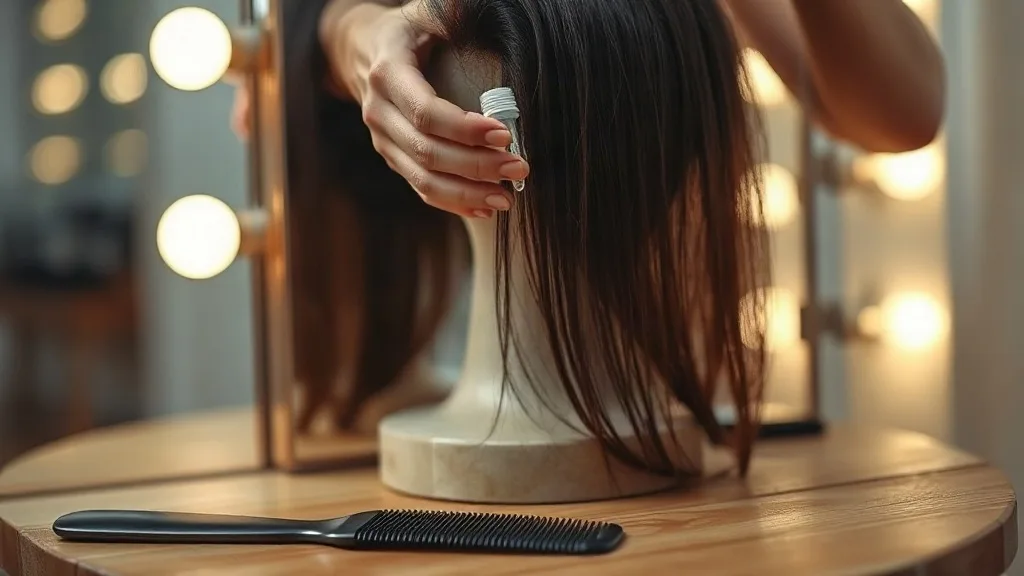
A serum is both your finishing tool and your first line of defense against tangling. In a wig, tangling happens mostly at the nape and beneath the crown, where strands rub against each other and against fabric. A good serum coats each strand with a thin, dry-touch film so fibers slide past one another instead of grabbing and knotting. That is the whole job, and it is a surprisingly hard job to do well.
- Delivers dry-touch slip rather than a wet, oily feel
- Smooths the cuticle so light reflects instead of scattering — that is what real shine is
- Reduces friction so ends stop snagging on collars, shoulder pads, and costume hilts
- Dries without tackiness and does not attract lint or dust
- Is labeled for the fiber type you own, or is genuinely safe on both
Ingredient-wise, look for a serum built on volatile silicones — cyclomethicone, dimethicone, dimethicone crosspolymer. They deliver immediate slip and then largely evaporate, leaving almost no residue behind. A touch of light argan, camellia, or squalane adds softness on human hair wigs without making the fiber feel heavy. Wig-specific lines from the major brands are formulated with exactly this balance in mind, and specialty detanglers marketed for lace wigs tend to be excellent on both fiber types.
Now the warnings. Heavy oils — coconut, olive, castor — do not absorb into synthetic fiber. They sit on the surface, dull the sheen, and collect dust. Argan oil serums are genuinely lovely on a human hair wig that you wash weekly, but applied to a heat-friendly synthetic they can make the fiber feel greasy by the third week. And if a serum is powerfully fragranced, think twice: scent lingers in a wig far longer than it lingers in hair, and a strong perfume can read as a smell in a small rehearsal room.
Sprays: Leave-Ins, Heat Protectants, and Finishing Mists
If serums are your pointe shoes — precise, applied sparingly, unforgiving of sloppiness — sprays are your warm-up. They are the broad, even application you reach for when you need coverage across a whole cap rather than three drops on the ends. Most wigs need at least two of them, and one is non-negotiable.
- Leave-in detangling spray: your daily refresh. Light, water-based, slightly conditioning, ideal for reviving a wig between washes
- Heat protectant spray: absolutely required before any hot tool, on both human hair and heat-friendly synthetic fiber
- Finishing or shine mist: a light, fine mist for the last step before you go on, ideally with no hold and no crunch
- Synthetic-specific conditioning spray: formulated to coat plastic fiber without sitting on it heavily, and worth buying separately if you wear synthetic regularly
The mistake almost everyone makes is spraying directly at the hairline. Most aerosols are alcohol-forward, and alcohol turns lace adhesive gummy and dries out knots until they start popping. Spray into your hands or onto a brush instead, then work the product where you actually need it — mid-lengths to ends. Keep water-based sprays off the lace, and never spray a product on and then immediately apply heat unless the label explicitly says it is a heat protectant.
Treatments: Masks, Deep Conditioners, and Bond Builders
Treatments are the weekly work — the barre class of wig care. They restore softness, rebuild some of what processing removed, and reset a wig that has started to feel wiry at the ends. They are also the category where people most often buy the wrong thing for their fiber type.
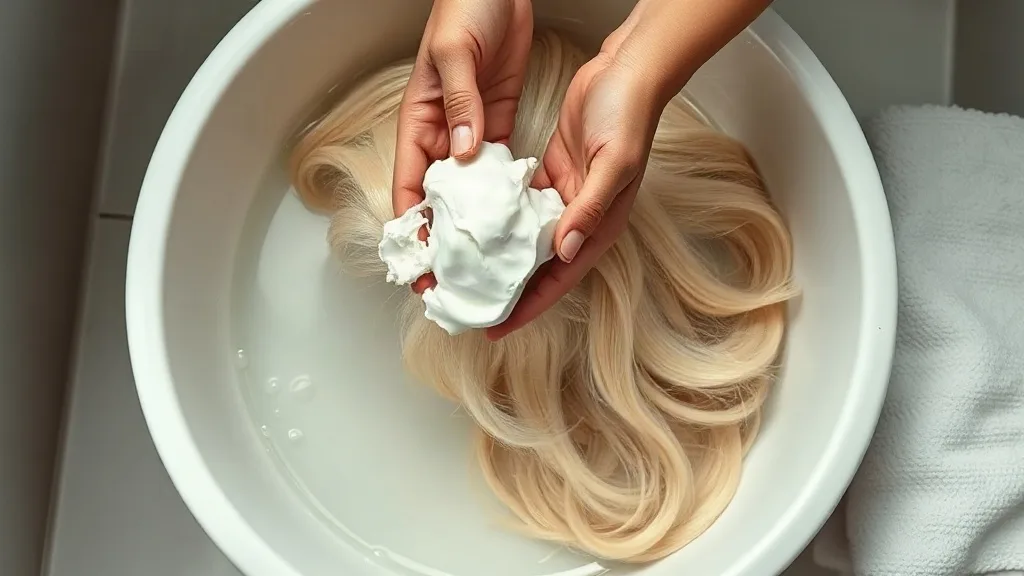
- Deep conditioning masks: the workhorse for human hair wigs. Apply mid-length to ends, leave fifteen to twenty minutes, rinse cool. Once a week in heavy rotation, once a fortnight otherwise
- Light protein treatments: helpful once a month if hair feels mushy or over-stretched, harmful if hair feels dry and brittle. Protein is a seasoning, not a meal
- Bond builders: be skeptical. They were formulated for living, chemically treated hair with moisture and sebum in play. Some do help processed human hair wigs, but overuse causes brittleness, and they do nothing for synthetic fiber
- Synthetic fiber treatments: stick to detanglers and conditioning sprays made for synthetic. A deep conditioner applied to a synthetic wig simply coats it, dulls it, and traps dust
One practical tip: do your deep conditioning on a wig block, not on your head. It keeps the cap from soaking through, protects the lace from conditioner residue, and lets you work the product through the lengths with a wide-tooth comb without stretching wet fiber.
Human Hair versus Synthetic: The One Rule That Changes Everything
If you remember nothing else, remember this: human hair wigs can receive most salon products, just applied more gently and rinsed more thoroughly. Synthetic wigs should never receive oils, deep conditioners, or high heat. Synthetic fiber is a surface, not a sponge. Everything you put on it stays on it.
- Human hair: sulfate-free shampoo, deep conditioner, light protein, silicone serums, and heat tools with protectant — all fine, all in moderation
- Standard synthetic: spray-on detanglers, synthetic-specific conditioning sprays, cold or cool water rinses, and air drying only
- Heat-friendly synthetic: heat protectant plus tools below the manufacturer's limit, typically around 350°F / 175°C, and never a tool held in one place
- Both types: cool water, gentle blotting, wide-tooth combs, and never a brush while wet
What I Would Skip Entirely
- Two-in-one shampoo and conditioner — the conditioning agents build up on the cap and around the knots
- Heavy oil treatments on synthetic fiber, no matter how good the packaging looks
- Alcohol-heavy aerosol hairspray near a lace front — it gums adhesive and stiffens knots
- Dry shampoo — the powder settles into the knotting and is nearly impossible to remove
- Anything labeled a growth serum. Wigs do not grow. That is the entire point of them
- Strongly perfumed products for stage work, where you are often a metre from an audience
The Routine I Give My Dancers
- After every wear: mist with leave-in detangler, comb from the ends upward with a wide-tooth comb, then two or three drops of serum on the ends and nape only
- Before any heat: heat protectant spray, always, no exceptions
- Weekly (human hair): wash in cool water with a sulfate-free shampoo, deep condition the lengths, rinse cool, blot in a towel, and air dry on a block
- Fortnightly (synthetic): cold-water rinse, synthetic conditioning spray, air dry on a block, no combing while wet
- Monthly: inspect the knots and hairline, check for buildup, and spot-clean the lace with a soft cloth
- Never: brush a wet wig, soak the cap, use hot water, or leave product sitting on the lace
A Note on Budget
You do not need a shelf of products. Three items do roughly ninety percent of the work: a leave-in detangling spray, a dry-touch silicone serum, and either a deep conditioning mask for human hair or a synthetic-specific conditioning spray. Together they usually cost less than a single good wig comb set and a can of the wrong hairspray. If you want to spend generously somewhere, spend it on the serum. Buy the shampoo on value — you are rinsing most of it away anyway.
Final Thoughts
A wig is a costume that has to behave like a body part. It has to shine under lights, hold still through a pirouette, and feel like hair when a partner's hand rests on the back of your head. None of that happens by accident. It happens because the products you choose are gentle enough to preserve the fiber, light enough to disappear, and consistent enough to be repeated eight shows a week. Buy fewer things. Buy the right ones. Then go out there and dance.