
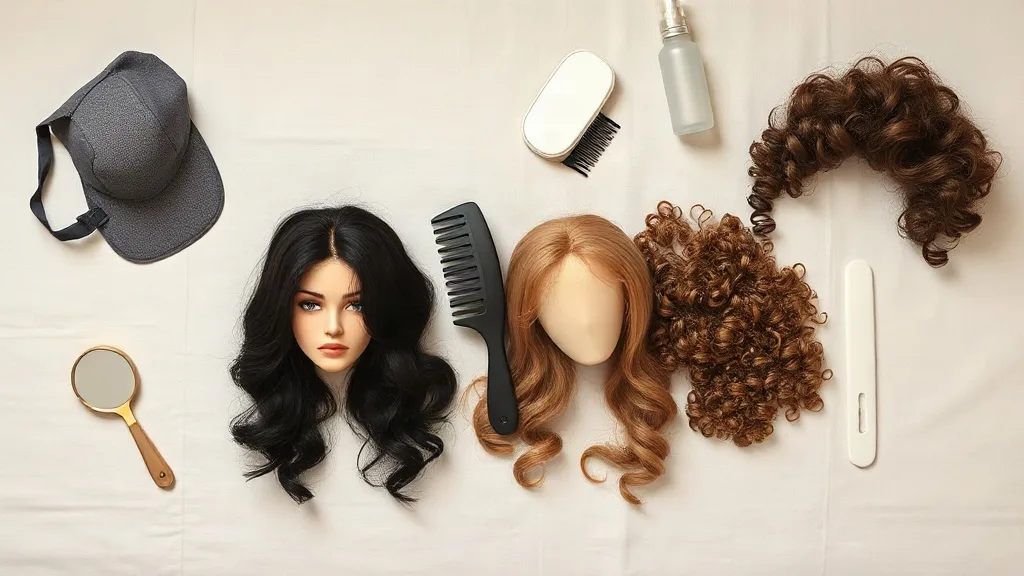


I've spent the better part of two decades behind a wig counter, and I'll tell you the same thing I tell anyone who walks in with a fifty-dollar budget and a wary expression: the cheap end of the market isn't a wasteland. It's a minefield. There's a difference, and it matters.
A minefield is survivable if you know where the craters are. Most budget wigs fail for one of four reasons — a shiny fibre that reads as plastic under daylight, a cap built for a mannequin rather than a head, a hairline that announces itself from across the room, or a density that gives up after three washes. None of those problems are caused by a low price. They're caused by bad choices made at that price.
Yes, I sell wigs for a living, so take my enthusiasm with the appropriate grain of salt. But I've also watched thousands of them come back through the door, and I know which cheap wigs stay on people's heads and which ones end up in a drawer by spring. This guide is about the former.
What Your Money Actually Buys at the Budget Tier
Price bands in wigs are not arbitrary. They map almost perfectly onto construction, and construction is what determines whether a wig looks convincing. Here's the honest ladder:
- Under $40: basic wefted cap, standard synthetic fibre, no lace, machine-made, often with a fixed part and a visible nape seam.
- $40–$75: entry lace front or a good basic cap in heat-resistant fibre, better density control, sometimes a monofilament part.
- $75–$120: human hair blends or higher-grade heat-friendly synthetics, improved hairlines, softer and more realistic movement.
- $120–$200: entry-level remy human hair, full lace fronts, hand-tied sections. This is the top of the budget tier and the bottom of the premium one.
Notice what's absent from that ladder: brand names. At the budget tier you're paying for construction, not heritage. A $60 lace front from a no-name seller and a $60 lace front from a legacy brand are frequently the same wig out of the same factory, with a different label stitched in.
The Five-Point Budget Wig Checklist
Before you look at a single product photo, put every candidate through these five filters. If a wig fails two or more, walk away no matter how good the sale price looks.
- Cap construction: a basic wefted cap is fine under a hat, a scarf, or a headband. It is not fine for a centre part and a ponytail. If you want a visible part, you want lace or monofilament there.
- Fibre and heat tolerance: standard synthetic cannot take heat. If you plan to use a curling iron or a blow dryer, you need heat-defiant fibre or human hair. Melting a cheap wig is the fastest way to turn $40 into nothing.
- Hairline and lace: look for lace that sits flat against skin with graduated density — sparse at the edge, denser an inch back. A hard, uniform line is the giveaway.
- Density: budget wigs often ship at 130–150% density, which photographs thick but can look helmet-like. For finer-faced wearers, lower density usually reads more natural.
- Return policy: the most underrated line item in the whole category. A wig that can be returned is worth fifteen dollars more than the identical wig that can't.
How I Judge a Cheap Wig
Reviews are only useful if the reviewer tells you how they tested. Mine is unscientific but repeatable, and you can run every step of it at home.
- The mirror test: does it look plausible at arm's length in daylight? That's the standard most people actually live at.
- The touch test: does the fibre feel cool and slightly coarse, like real hair, or slick and warm like doll hair?
- The six-week test: does the cap still sit flat, the part still lie down, the ends still avoid matting after six weeks of normal wear and three washes?
- The wash test: cheap fibre sheds and tangles after washing. A good budget wig comes out of a gentle wash with its shape intact.
- Cost per wear: a $150 human hair wig worn 200 times costs 75 cents a wear. A $30 synthetic worn four times costs $7.50. Cheap is a maths problem, not a price tag.
The Shortlist: Budget Wigs That Earn Their Keep
These are the archetypes I'd point a friend toward — described by category rather than by brand, so you can apply the logic to whatever is actually in stock at the shop or the marketplace you're browsing.
1. The Everyday Basic-Cap Synthetic ($25–$40)
The workhorse. A short or shoulder-length synthetic on a wefted cap with a fixed part, sold in a dozen colours by sellers who don't have a marketing department. It will not fool anyone in direct sunlight with the part exposed, and it doesn't need to — worn under a beanie, a scarf, a hat, or with a headband over the part, it looks completely normal.
Where it wins: washing is trivial, it holds a style forever, and you can buy two and rotate them so neither wears out. Where it loses: heat is fatal, the part is fixed, and the cap may run snug. Verdict: the best value in wigs, provided you accept the constraints.
2. The Budget Lace Front Synthetic ($45–$70)
This is where cheap wigs stop looking cheap. At this price you're getting a pre-plucked lace front, usually 13x4 or 13x6, with baby hairs and a graduated hairline. On colour, stick to darker shades — dark roots hide a multitude of sins, and inexpensive lace blends far better with deeper skin tones and dark hair.
Where it wins: a genuine, wearable hairline and a part you can move. Where it loses: lace quality is where the corners were cut, so it may need trimming, tinting, and a little concealer along the parting. Budget half an hour to prep it. Verdict: the single best upgrade you can buy with an extra twenty-five dollars.
3. The Heat-Friendly Shoulder-Length Synthetic ($60–$90)
Heat-defiant fibre is the most misunderstood upgrade in the budget tier. It doesn't behave like human hair — it has a memory, and it will slowly creep back toward its factory style — but it lets you use a low-heat iron, soften a too-perfect curl, and add a little bend around the face.
Where it wins: styling flexibility without the human hair price or the human hair maintenance. Where it loses: you must respect the temperature ceiling, usually around 350°F / 175°C, and anything above it fuses permanently. Verdict: buy it if you style your hair more than once a week; skip it if you don't.
4. The Human Hair Blend Bob ($80–$120)
A blend is typically human hair mixed with synthetic, or a lower-grade human hair with a rougher cuticle. It moves better than pure synthetic, takes a little heat, and can be re-styled by a professional. On a sharp bob, where movement matters less than line, blends are genuinely hard to distinguish from full human hair at a glance.
Where it wins: realistic movement, natural lustre, and the ability to be trimmed into shape. Where it loses: blends tangle faster than remy human hair and can't be lightened. Verdict: the sweet spot for anyone who wants a believable, wearable wig without crossing $150.
5. The Entry Remy Human Hair Lace Front ($130–$190)
This is the top of the budget tier and, honestly, the bottom of the good stuff. Entry remy human hair usually means aligned cuticles but thinner density, a shorter length, or a slightly coarser texture than premium hair. What you're getting is real hair that can be coloured darker, heat-styled properly, and worn for a year or more with care.
Where it wins: longevity and cost per wear. A $160 wig worn three times a week for a year is under a dollar a wear. Where it loses: it needs actual maintenance — sulphate-free washing, conditioning, a stand, and a protective routine. Verdict: the cheapest wig you can buy in the long run, if you're willing to treat it like hair.
6. The Clip-In Topper Wildcard ($30–$60)
If your thinning is concentrated at the crown or along the part, a full wig is overkill and a topper is the bargain of the category. A basic synthetic topper clipped into your own hair adds volume and covers a widening part for a fraction of a wig's price.
Where it wins: it works with your existing hair, it's fast, and nobody expects it to look like a full head of hair — which lowers the bar considerably. Where it loses: it needs enough of your own hair to clip into, and the shade match has to be close. Verdict: the most underrated budget purchase in the entire market.
Where Cheap Wigs Hide Their Real Costs
A low sticker price is not the same as a low total cost. Watch for these five.
- Shipping and returns: a $35 wig with $12 shipping and no returns is a $47 wig you can't reject.
- Replacement frequency: if it dies in six weeks, $35 four times a year beats $130 once.
- Prep supplies: tint spray, lace adhesive, a wig cap, a stand, and a wide-tooth comb add $25–$40 to your first purchase.
- Styling time: an hour of prep per wear is a real cost if your mornings are tight.
- Colour correction: cheap blonde is the least convincing colour in the category. Dark shades are far more forgiving.
How to Make a Cheap Wig Look Expensive
Three quarters of the difference between a $40 wig and a $400 wig is what happens in the ten minutes after you take it out of the box.
- Pluck and thin the hairline. Almost every budget lace front is too dense at the front edge.
- Cut the lace properly, in small sections, close to the hairline but never through it.
- Powder the part. Concealer or foundation along the parting line kills the shine and softens the knots.
- Wear dark shades. Black and dark brown budget wigs beat blonde and platinum every single time.
- Add a hat, a scarf, or a headband for the first week while the fibre settles.
- Dry shampoo on synthetic fibre reduces shine better than any dedicated product.
- Trim the ends. Blunt, factory-cut ends look artificial; a light point-cut at home fixes it.
When to Stop Being Cheap
There's a point where frugality turns into false economy. If you wear a wig daily, if you need a visible part and an exposed hairline under bright light, if you want to colour or heat-style regularly, or if your scalp is sensitive to synthetic fibre and cap seams, the budget tier will cost you more in replacements and frustration than one good purchase.
But that point arrives later than most people think. I've seen clients wear a $45 lace front synthetic five days a week for a year and look fantastic — because they chose the right construction, prepped it properly, and replaced it before it faded. Frugality isn't the enemy of looking good. Bad construction choices are.
The Bottom Line
Cheap wigs work. They work dramatically better than they did a decade ago, and the gap between a $50 wig and a $250 wig is far narrower than the price difference suggests — as long as you spend your money on construction instead of branding, and your time on prep instead of hoping.
Start with a budget lace front in a dark shade and heat-friendly fibre. Learn to pluck a hairline and powder a part. Wear it for six weeks and do the maths on cost per wear. Then decide whether you need to spend more — because you might find you don't.